
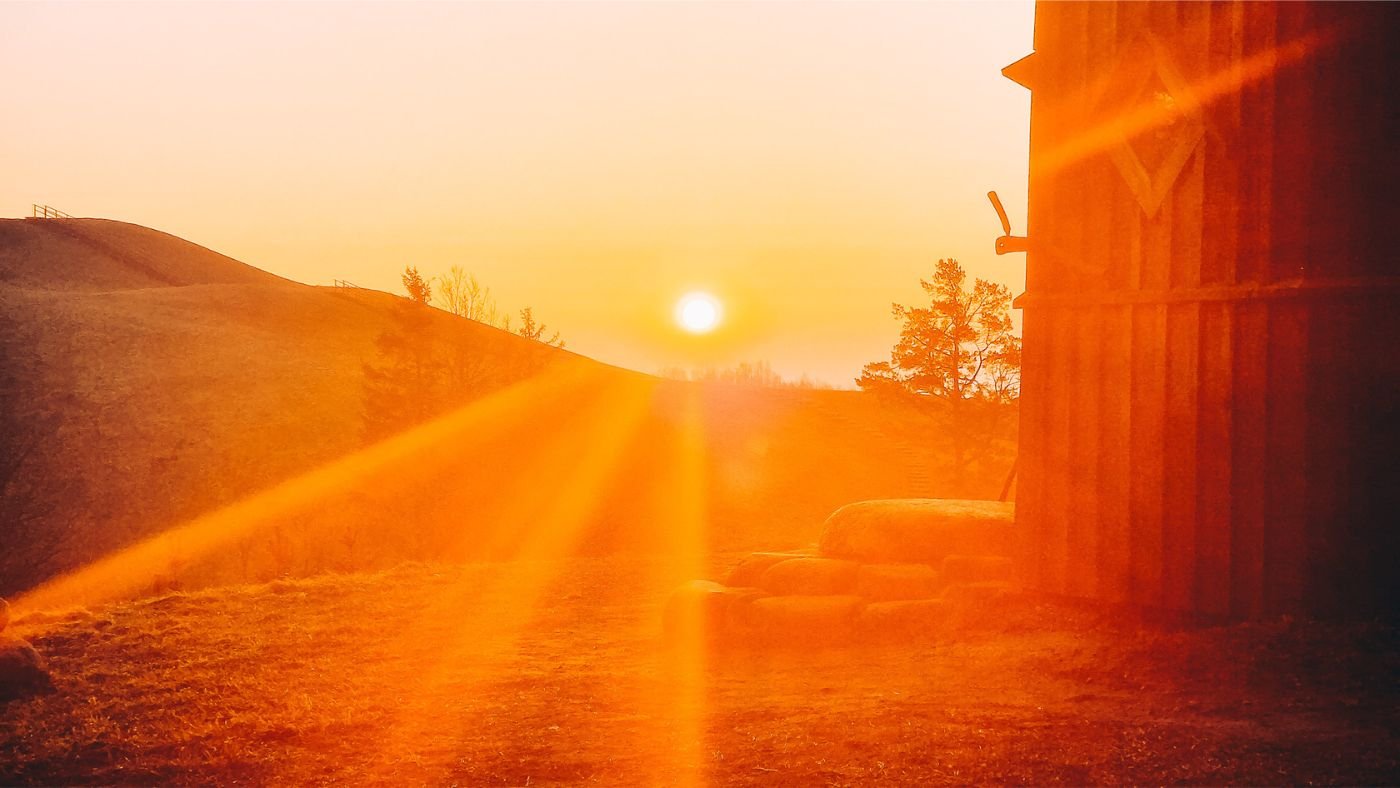
When the world comes alive again
Here I am again with my heresies, trying to knock on people’s heads and touch their hearts. I come back because I can no longer keep silent as I watch how easily we grow used to a world that is becoming foreign to us.
When did we stop seeing the Earth? Not a globe or a map, not a recreational or private plot, not deposits of mineral resources. The Earth that holds us. The Sun that rises every morning and reminds us that life does not begin with our will. A living tree that we cannot assemble from a blueprint or print on a 3D printer. Our ancestors did not choose between life and the sacred; for them these were not two separate things. But we have separated them so thoroughly that we now have to look for the way back.
For several centuries we have looked at the world more and more as if it were a mechanism. I do not blame science or tools. Science helps us understand the Sun, the Earth’s history, our own bodies. The trouble starts when we confuse knowledge with the right to rule, and the ability to measure something with proof that it means nothing more. A machine can be an excellent helper. But once we ourselves begin to look at the world as a machine, we start to think that every one of its cogs turns for our benefit. Even a living human being, I as much as you, has become a resource.
This is how the sacredness of the Earth is eclipsed. First in our outlook, then in our actions. Finally within us, where we gradually lose the ability to feel that what is alive is not merely our property. We are proud of having uncovered so many of the world’s secrets. But have we learned to be with the world, rather than only taking it apart?
Sometimes I hear: there goes the pagan again, wanting to drag people back into the past. No. It is impossible to return to the past, and I am not proposing it. I propose carrying into the future what we never had the right to throw away. Our old songs, customs and folk art are not just beautiful exhibits. A different relationship with nature still lives in them: the ability to recognise the same force of life in people, animals, trees, even in a tiny drop of dew. For me the names of the old deities are ways of speaking about forces we did not create but which we are nonetheless compelled to obey.
A nation’s memory is not so easily erased. Sometimes it lives in the melody of a song, in the customs of a festival, in a hand that stops before dropping litter or breaking a branch. Today we are weaving our life anew, and it is up to us which threads we weave into it. If we take from the old way of seeing the world only the look of the rites and not respect for life, we will have taken the husk and thrown away the kernel.
There is an old philosophical concept, anima mundi, the soul of the world. It is a term very close to me: let us stop behaving as if we lived in a dead world. We will begin to recognise the soul of the world when we grasp the connection once more. When we are no longer afraid to admit that human consciousness also has room for what cannot be counted or put into words.
That is why we must bring back what our civilisation long pushed to the margins: a sense of the Earth as a living organism, care for the body and its health, the value of the feminine, attention to a person’s inner world. So that we finally stop regarding the ability to care, to listen and to protect as weakness. How much longer will we call progress an order in which some can grow only because others are held down? What right do we have to boast of a civilisation whose comfort is paid for by exploited people and an exhausted landscape?
For me the old world is not an image of a lost paradise, a fancy that in the past everyone lived without conflict. There is no need to turn the past into a fairy tale. But it makes me ask: why do we so often give the name civilisation to hierarchy, authority and the power to force obedience? I would like to call civilised a world in which moral and artistic values are created and cherished, in which no one is humiliated because of their sex, and in which strength does not mean the right to use the weaker. If such a definition seems too bold, perhaps our usual definition is too narrow.
Waiting for a new world easily turns into a comfortable posture. We wait for a government decision, an agreement “at the top” or progress in artificial intelligence that will open the gates and announce that from today we live differently. But the gates will never open if everyone just stands in front of them. I cannot change the world on my own. But I can stop pretending that my choices have nothing to do with it. My responsibility for the future begins with how I speak about another person, how I treat my body, what I leave behind me in the forest and what I pass on to my children. Real change is not just a thought in the head. It has to show in our actions.
That takes the courage to remain oneself. One must dare to hold one’s own opinion even when the crowd around asserts with one voice what you no longer believe. You part from the crowd not because you want to stand out, but because you refuse to assent to what destroys life, even if assenting would be easier. Sometimes that means disagreeing with greed. Sometimes with your own comfort. Awareness does not begin when you correctly repeat a fine thought. It begins when the thought turns into action.
And where can one draw the strength not to tire? Where can one find that water of life that lets you walk your own path without breaking? I find it in the songs of our ancestors and in nature’s symphony at dawn or sunset, under a starry sky on a clear summer night and among people with whom I can speak without a mask. I find it by the fire that I and like-minded friends from Girių Romuva or Girių Inspekcija sometimes light, and on Šatrija hill, carrying the safeguarded fire as the Sun rises. I find it in celebrating the calendar festivals with like-minded people and in activities in which I see meaning and the effect they have on the world around us.
I come again and again with my heresies because I believe that people can open their eyes. That we can understand more than just price and profit. That an old way of seeing the world need not hinder us from moving forward, but can remind us of what must not be trampled as we go. If the Earth becomes alive for us again, perhaps the question we ask every morning will change too. Not “how much will I be able to take from her today?”, but “what can I do today so that we all flourish, we and the world around us, as one?”
This is how I understand the path of a conscious person. Not as a return to yesterday, but as responsibility for tomorrow, without breaking the bond with what has been alive since ancient times.
Donatas Greičiūnas