Giving back to the Earth from which we take
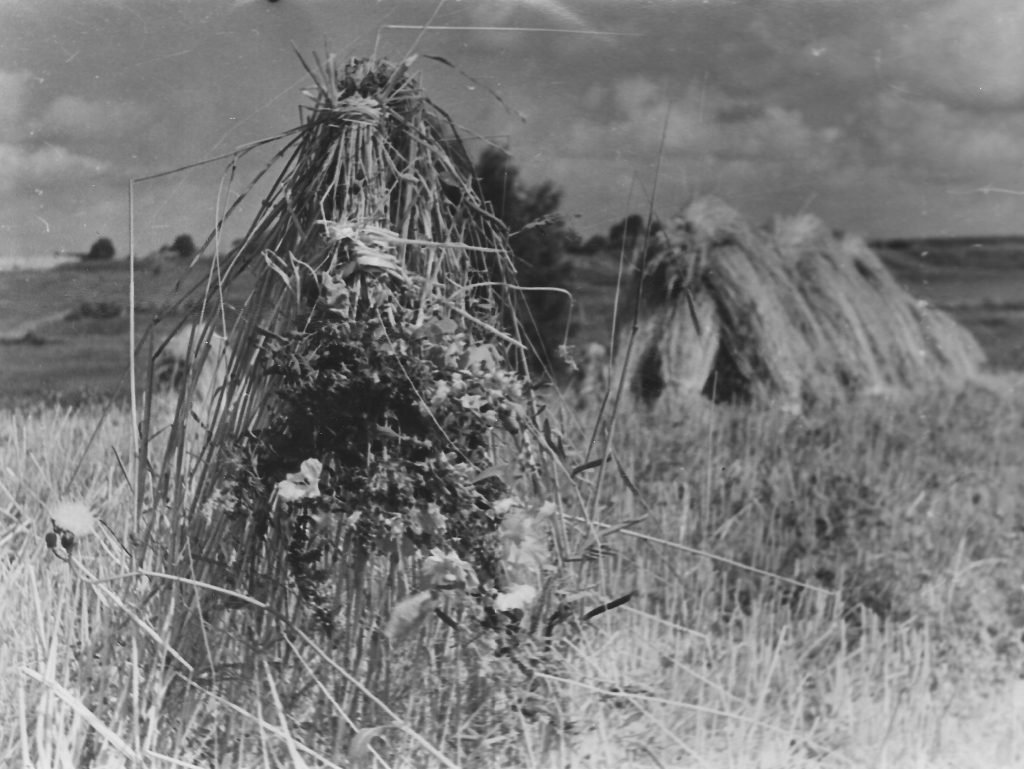
In some parts of Lithuania, at the start of the rye harvest, people were in no hurry to cut the whole field as fast as possible. First a few handfuls of rye were cut. From them a small sheaf was tied: the “guest” (svečias), the “master of the house” (gaspadorius), in some places the “old man” (diedas). Where the sickle had touched the first stalks, bread and salt were laid on the ground or buried. The sheaf was carried home and set in the most honoured corner of the house. It was the first sign of the harvest to come in from the field, but not yet ordinary food, nor a decoration for the home. Before becoming human bread, the grain remained for a moment what it had been all summer: a gift of the earth.
The folklorists who recorded this custom in various places in south-eastern Lithuania found more than one version of it. Sometimes bread and salt were placed inside the first sheaf; sometimes it was threshed first, in the hope that the bread would go a long way; and in some places ears gathered from different parts of the field were tied together and given a home in the corner of honour (krikštasuolė). In the surviving accounts Christian words can already be heard and pictures of saints seen, yet the act itself, setting the first portion apart from the whole harvest to come, is an echo of much older thinking. Detailed testimonies of this custom were published by Rita Balkutė and Nijolė Laurinkienė, researchers at the Institute of Lithuanian Literature and Folklore, in the publication “The rye harvest: the guest, the jievaras, the wreath”.
Nevertheless, when speaking of the old faith we must beware of a beautiful but deceptive certainty. We have no book of rites written by the ancient Balts themselves, setting out what to do, when and in what words. What we know has reached us from medieval and early modern chronicles, church reports, later ethnographic records, folklore and archaeology. The sources are of different ages, written down in different Baltic lands, often by foreigners and by authors hostile to the old religion. The collection “Sources of Baltic Religion and Mythology”, presented by the National Library of Lithuania, clearly warns for this reason that the late testimonies show traditions already altered and intertwined with Christianity. So it would be a mistake to mould from a few fragments a single ceremony fit for all Balts and all ages. But the fragments repeat the same idea so persistently that it is hard to overlook: the first portion did not belong to humans alone.
The first portion: not yet human property
In the study of religion, the offering of first fruits or the first part of the harvest is called primitiae. In her study “The first morsel and the first sip are for the gods” Nijolė Laurinkienė shows that in the Baltic tradition the first portion could be set apart at the start of the rye harvest, at its end, at threshing and on sitting down to the ritual feast. In Lithuania the cutting of the first sheaf of rye in some places took place even before the harvest proper. People prepared for it by fasting and performed it towards evening, sometimes in secret. The bread and salt left for the earth at the place of cutting were not crumbs dropped by chance but a portion deliberately given.
In the lands of the Western Balts the sources give a different but related picture. The Treaty of Christburg of 1249 mentions the Prussian Kurkas (Curche), whose image was solemnly adorned and worshipped once the fruits of the fields had been gathered. In the 17th century Matthäus Prätorius wrote that Kurkas received the first cleanly threshed wheat, rye, barley, oats, beans, peas and lentils, as well as the first fish, meat, flour, mead, beer and milk. Some of these goods were burned on embers. Elsewhere the first of the harvest was associated with Patrimpas. The names of the deities and the place and form of the rites changed, but the recurring order remained: before people began to use the goods, a part of them was taken out of everyday circulation and returned to the realm of the sacred.
Here lies the essential difference between an offering and a transaction. In a transaction we give as much as is needed to obtain the thing we want. An offering begins with the recognition that you have already received what you did not create by yourself alone. A person can plough a field, sow and reap, but cannot by their own will command the seed to sprout, the rain to come on time or the soil to keep its life year after year. Their labour is necessary, but not all-powerful. Giving away the first portion curbed the urge to call everything one’s own at once.
The historical sources, of course, show more than thanksgiving. In making offerings people asked for a future harvest, health, rain, the fertility of their animals and protection for the home; sometimes the act was accompanied by fear of angering a deity or the power of a place. Rimantas Balsys, who has studied prayers of the 14th–17th centuries, notes that people turned to the gods mostly in spring and autumn, at sowing and when bringing in the new harvest, asking for help and giving thanks for the goods that had grown. There is no need to turn antiquity into a sweet tale of perfect ecological harmony. Yet both petition and thanks rested on relationship. People did not speak into a void. They addressed a world they held to be alive and able to answer.
The fire that ate together with people
Today throwing food into the fire may look like wasting it. In the old farmhouse such an act meant something quite different. Fire was not a mute tool for heating a pot. It had to be kept from uncleanness, carefully covered with ashes in the evening, and not insulted by spitting or kicking. People spoke to it as to a living member of the household. So when eating, the family did not leave it out entirely either.
Jonas Balys, summarising Lithuanian beliefs about the home hearth, records the custom of sprinkling salt when cooking so that a little of it went to the fire. When a stew boiled over onto the flame or salt was spilled, people said: “Holy Gobija, be satisfied.” The parental instruction to “feed the little fire” survived in late ethnographic records, so what we see here is a folk tradition that had long been changing, not an untouched description of a pre-Christian rite. Yet the idea itself is remarkably clear: the fire has its share. Balys’s text can be read in the digitised publication “Readings in Lithuanian Folklore”.
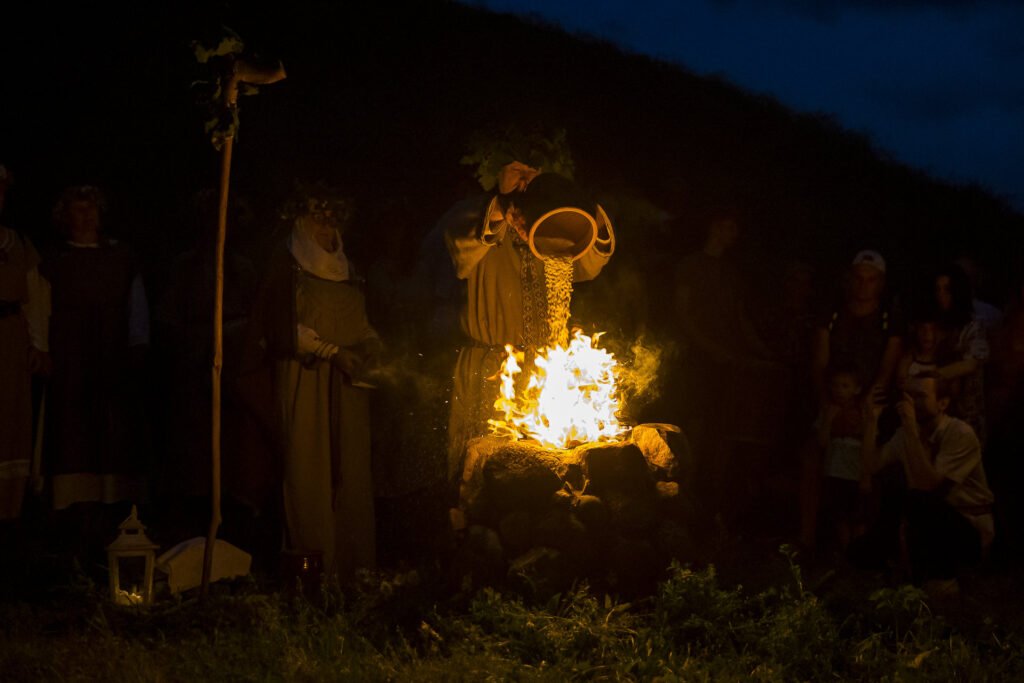
In a ritual setting the fire’s share could be considerably greater than a pinch of salt. In the threshing barns (jaujos) of Lithuania Minor described by Prätorius, grain or fish was placed on a hollowed board, mead, milk or beer was poured over it and it was set on prepared embers. The first of the harvest burned in this way was intended for the gods. Another 17th-century testimony tells of a Latvian plea to Perkūnas to send rain: a ladle of beer is carried three times round the hearth and then the beer is poured into the fire. So the flame could be both a sacred being that is itself fed and the path by which an offering is passed on to another deity. Not every morsel thrown into the fire can automatically be called an offering to Gabija: in the sources the addressees of the rites vary.
This is an important detail for those who nurture the native faith today as well. Tradition is not a single frozen picture. In it fire has many faces: guardian of the home, helper in preparing food, centre of the rite, a force that carries the offering, mediator of the bond between sky and earth. To leave it a share meant drawing into the common circle that without which the bread would not have baked and a cold house would not have become a place to live.
Žemynėliavimas: first, for the earth
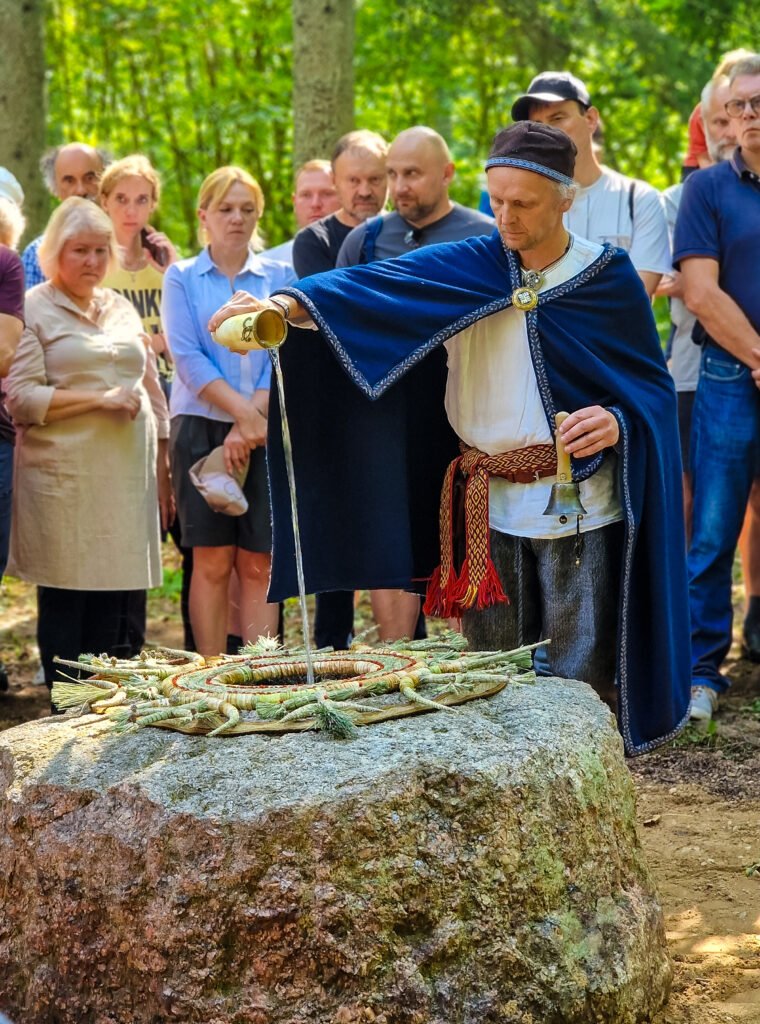
Not all offerings rose as smoke. Pouring a drink onto the ground was so prominent that in Lithuania Minor it had its own name: žemynėliavimas. The procedure described by Matthäus Prätorius is simple: before drinking, the master of the house poured a little beer for Žemynėlė. He did so in thanks for her gifts and to ask for blessing. In the Encyclopedia of Lithuania Minor Daiva Vaitkevičienė stresses that žemynėliavimas was not a chance spilling of drink but a duty performed at feasts, communal gatherings (sambariai), funerals and on other significant occasions. The first sip had an addressee even before it reached human lips.
The 16th-century historian Maciej Stryjkowski described a late-autumn thanksgiving feast for Žemininkas, guardian of the homestead and the tilled fields. Before people began to eat, the person leading the rite tore off a piece of every dish and threw it under the table, onto the stove, under the benches and into the corners of the house. As early as the 15th century Jan Długosz wrote about Lithuanian autumn rites held in sacred forests at the beginning of October: at the communal feast that followed the sacrifice of animals, food was dropped and drink poured out for the spirits. The chronicler’s gaze was foreign and hostile to the old religion, so his account cannot be accepted uncritically. But the motif of sharing food with the unseen matches other, later testimonies.
A share was also left in the field. At the end of the rye harvest a tuft of uncut stalks was plaited into a braid called jievaras, jovaras, the “beard” (barzda) or by other names. Bread and salt, sometimes coins, were placed beneath it, and all this was covered with earth. Not everything that had grown had to be carted off to the barn. The tuft of grain left in the field marked a boundary: people had finished their work, but had not carried the field away down to the last grain.
Offerings in sacred places
Offerings were not left just anywhere. Hills, groves, springs, rivers, stones and bogs became sacred not because they made a beautiful setting for a rite. They themselves were understood as places where the divine appears, acts or is especially near. The Universal Lithuanian Encyclopedia notes that natural objects were associated with gods and mythical beings and so became places where the sacred was revealed. A person did not come to such a place as to an empty patch of land that they briefly “make sacred” with their event. They came as a guest.
The archaeologist Vykintas Vaitkevičius relates that about five thousand years ago stone and flint axes were offered in sacred waters and wetlands, and later bronze axes, spearheads, sickles and ornaments. Historical sources mention sacred forests and oak groves in which offerings were made to gods and ancestors. At the same time the researcher warns against one image created by the modern imagination: fire was kindled beside sacred stones, not on them, because heat splits a boulder. His explanations and his caveats on assessing the sources can be found in a conversation about the ancient sacred sites of the Balts.
Sometimes the memory of the old ways survived until quite recent times. In stories recorded in the first half of the 20th century about the “Laumės’ Table” of Paindrė, a large stone near Dusetos, it is said that at Whitsun people gathered by it, laid out bread and meat and poured beer and mead, asking the laumės (fairies) to protect the fields. In one story, beer that spilled from a barrel which had rolled off the stone was not rescued, because it was the laumės’ share. This testimony is not a direct record of an ancient rite; it is a late layer of local memory. But it faithfully preserves the logic of the relationship: it was not fitting to take from a place and leave nothing there.
Fine words alone are not enough for the Earth
Today the word “offering” or “sacrifice” often calls up two opposite images. For one person it is a relic of a cruel past; for another, a romantic handful of grain scattered onto a fire altar. Both images are too narrow. The old sources tell of animal sacrifice as well as the giving of food, drink, grain, fish, salt or crafted objects. But the essence of an offering is not defined by its price. What matters most is that a person voluntarily gives up a part of what they could use for their own benefit and by this act recognises the right of others to be partners in the relationship.
That is why reciprocity is more than a polite “thank you” to a deity. It sets a limit on appetite. If the earth feeds us, it must not be left exhausted. If the forest gives timber, mushrooms, berries, coolness, water and shelter, one cannot walk out of it as though one had been to a shopping centre. If a river lets us drink and waters the fields, returning sewage to it is no thanks: it is a desecration of the relationship.
A modern offering need not be an object given up. Sometimes the true offering is a tree we saved from felling though we could have sold it. A stretch of bog we did not drain for the sake of a few extra hectares. A shore we did not build on. Time spent pulling other people’s rubbish out of the forest. Profit we gave up by choosing slower farming that harms the earth less. A comfort we limited so that those who cannot bargain with us may also live: birds, insects, amphibians, trees, mosses, fungal mycelium.
The forest is not repaid merely by planting as many seedlings as trunks were felled. A forest is not a number of trees. We must preserve old trees, hollows, dead wood, wet hollows, forest edges and quiet during the nesting season: everything that rows of saplings will not quickly restore. For water, words of thanks at the spring are not enough: its purity begins across the whole catchment, in the substances used on the fields, in properly treated waste water, undrained bogs and protected banks. The fertility of the soil is protected not by symbolically kissing the ground but by not leaving it bare, not letting it dry out and blow away, returning organic matter, growing different plants and giving it time to recover.
Here the rite meets an awkward question: what did it change after the fire went out? One can speak Žemyna’s name and at the same time spray the land so that everything in it that brings no direct profit dies out. One can offer grain to Gabija and then burn waste and poison the air. One can hold a solemn rite in the forest but leave plastic behind, or keep silent while an old forest is felled nearby. In that case the rite does not strengthen the bond; it only hides its absence.
A rite without responsibility is mere theatre. This is not a call to give up rites. On the contrary, it gives them back their weight. An offering at the fire should remind us of what we will not take from the earth. The pouring of beer should oblige us to protect the water from which that beer was made. Honouring the first of the harvest should lead to care for the soil, so that grain can still grow in it after us. A word becomes real when it has consequences.
The customs our ancestors left do not provide a ready-made modern environmental law. They do not say how wide a protective strip along a shore should be or how much dead wood must remain in a forest. But they leave what no law will work without: a sense of measure and the understanding that humans are not the only users of the world. The first sheaf, the slice of bread beneath the jievaras, a few drops of home-made kvass for the earth and a pinch of salt for the fire all speak one language: not everything we are able to take belongs to us.
A true relationship with Žemyna is revealed not only in speaking her name. It can be seen in a clod of soil the rain has not washed away; in a spring that needs no warning not to drink; in a forest where room has been left for a tree to grow old; in air our comfort has not polluted. The old offering reminded people that receiving always creates a duty. Today we can change the form of the offering, but not its essence: the Earth must be left with life after we have taken our share.
Sources used
- Nijolė Laurinkienė, “The first morsel and the first sip are for the gods”, 2020.
- Rita Balkutė, Nijolė Laurinkienė, “The rye harvest: the guest, the jievaras, the wreath”, 2012.
- Rimantas Balsys, “Prayers to the old Lithuanian and Prussian gods in written sources of the 14th–17th centuries”, 2008.
- Daiva Vaitkevičienė, “Žemynėliavimas”, Encyclopedia of Lithuania Minor.
- Dalia Senvaitytė, “Fire in the old Lithuanian tradition”, 2005.
- Vykintas Vaitkevičius, “Baltic sacred sites: at the origins of Lithuania’s protected areas”, 2023.
- The four-volume collection compiled by Norbertas Vėlius, “Sources of Baltic Religion and Mythology”, 1996–2005.