

In the Land of the Grass-Snake King: an early-winter hike around Salakas
December 5 @ 9:30 am - 5:00 pm
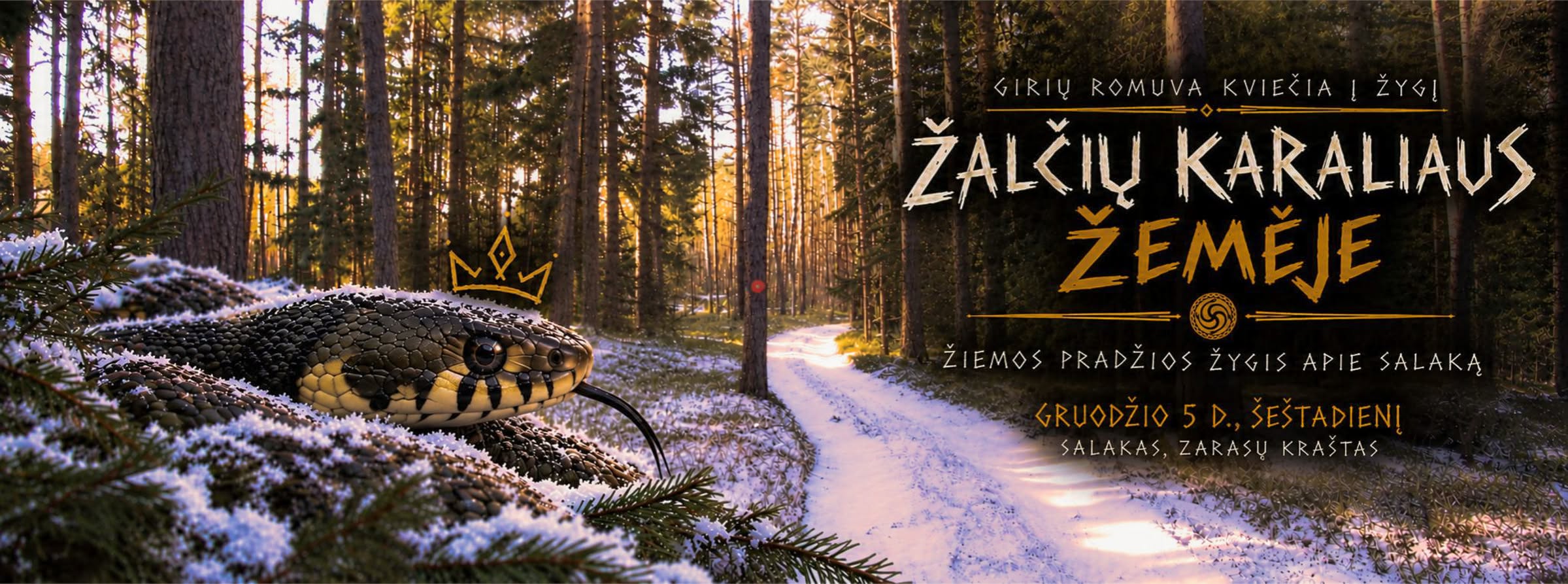
GIRIŲ ROMUVA invites you on a hike
Saturday 5 December · Salakas, Zarasai region
There are places in Lithuania whose name has to be read backwards. Salakas is one of them. Read it from the other end and you will hear the beating of wings: Sakalas, the falcon. Legends tell that in ancient times these forests teemed with game, and the nobles held hunts and bred falcons here. So that Girinis, the guardian of the beasts, would not see through the hunters’ designs, people began calling the place from the other end of the word, and so it is called to this day. Another legend says that the land, surrounded by lakes, resembled an island (sala), and the fishermen who lived on it were called salokai by their neighbours.
Salakas has been mentioned in written sources since 1387, but its memory is far older. It is said to have been founded by Duke Utenis. There are also tales of a gigantic town, seven versts long and seven wide, with a castle bearing the strange name of Didžioji Laba.
The capital of the Grass-Snake King
The greatest mystery of Salakas is Želmis, the King of the Grass Snakes (Žalčių karalius). The lake-rich north-east of Aukštaitija is one of the two regions of Lithuania where the tales of the man-serpent have survived most vividly, and they cluster precisely around Salakas. On the island of Lake Luodis, they say, Želmis’s castle sank, and the serpent’s palace still stands in the depths of lakes Salos, Lobė, Luodis and Kretuonas. Climb the tower of Salakas church and you would survey his whole domain.
Želmis is not a ruler adorned with a glittering crown. He is a tiller of the soil and a craftsman, the guardian of young shoots (želmenys), and even his name comes from them. He dresses in linen and homespun, scorns trinkets, scatters grain into the soil, opens the earth for the sprouts and comes to the aid of those in need. He also has a sword with a sun in its hilt, not for waging war but for fencing in the young crops. His struggle is a struggle for happiness, and not for himself alone but for all, even strangers, those who speak differently and dress differently.
Above all Želmis is connected with the Sun. When the sun turns towards longer days and first shines into his parlour, the Grass-Snake King wakes and prepares again for his journeys. We will walk in December, when the Sun grows still before the solstice. The grass snakes sleep beneath the earth, the shoots beneath the snow, and the earth quietly guards what it hides.
It is also interesting that in Salakas the “kings” never died out. In one local family that traces its descent from Želmis, the royal name passed from generation to generation, and one of its men, a forest ranger, was called by the people the king of the forests. So where else should Girių Romuva go?
The route
The path leads through a murmuring pine forest that is different in every season. In summer it is generous with berries, in autumn with mushrooms; in spring it rings with returning birds; and in December it is quiet, smells of resin and, if winter is generous, lies blanketed in snowdrifts. The glacier left its traces here: hills and hollows that keep the pine forest from becoming uniform.
By Lake Ganiava giants sleep. The Giteniškė barrow cemetery consists of nine burial mounds, up to a metre and a half high and up to twelve metres across. People call them giants’ graves (milžinkapiai) and tell of mighty men buried in them. Burials were made in this way in eastern Lithuania for almost nine centuries, from the turn of the 3rd and 4th centuries right up to the 12th. Here we will pause to honour the ancestors.
Lake Ganiava and the bog surrounding it are a nesting site for birds, so from April to August we leave the bog reserve to them. In December peace reigns here.
Next awaits Mergežeris, impressive and always cold. Legend has it that a drowned maiden lives at its bottom and lures men down to her in the depths. So, men, keep close to the group. Having walked round the lake we will wade into a bog where elk have trodden a path. In summer it is heady with the scent of marsh tea, and on the eve of winter we may still find cranberries glowing red in the moss. Once we have waded out, the coolness and freshness of the pines will embrace us again.
At the end of the hike, on the left side of the road, rests the old Jewish cemetery. Jews once made up the larger part of Salakas’s inhabitants. The cemetery stands apart from the town and is overgrown, because according to Jewish custom everything that grows in cemetery soil is sacred, so trees are not felled here. In memory of the dead a small stone is placed on the grave. It is a quiet sign that the people who lived here are not forgotten.
Giants in the barrows, a maiden in the depths of the lake, the Grass-Snake King beneath the earth: this land is full of those who sleep but have not vanished. We will come to visit them while the Sun is still only preparing to return.
Good to know
- Date: Saturday 5 December
- Meeting point: 9.30 am in the car park by Salakas church
- Bring: warm, waterproof boots (it’s a bog! there will be some wading), a flask of tea, snacks
- Registration and questions: info@vietosdvasia.lt
We will confirm the details of the route later, but we can already say that this will be a hike through one of the most beautiful forests of Aukštaitija.