
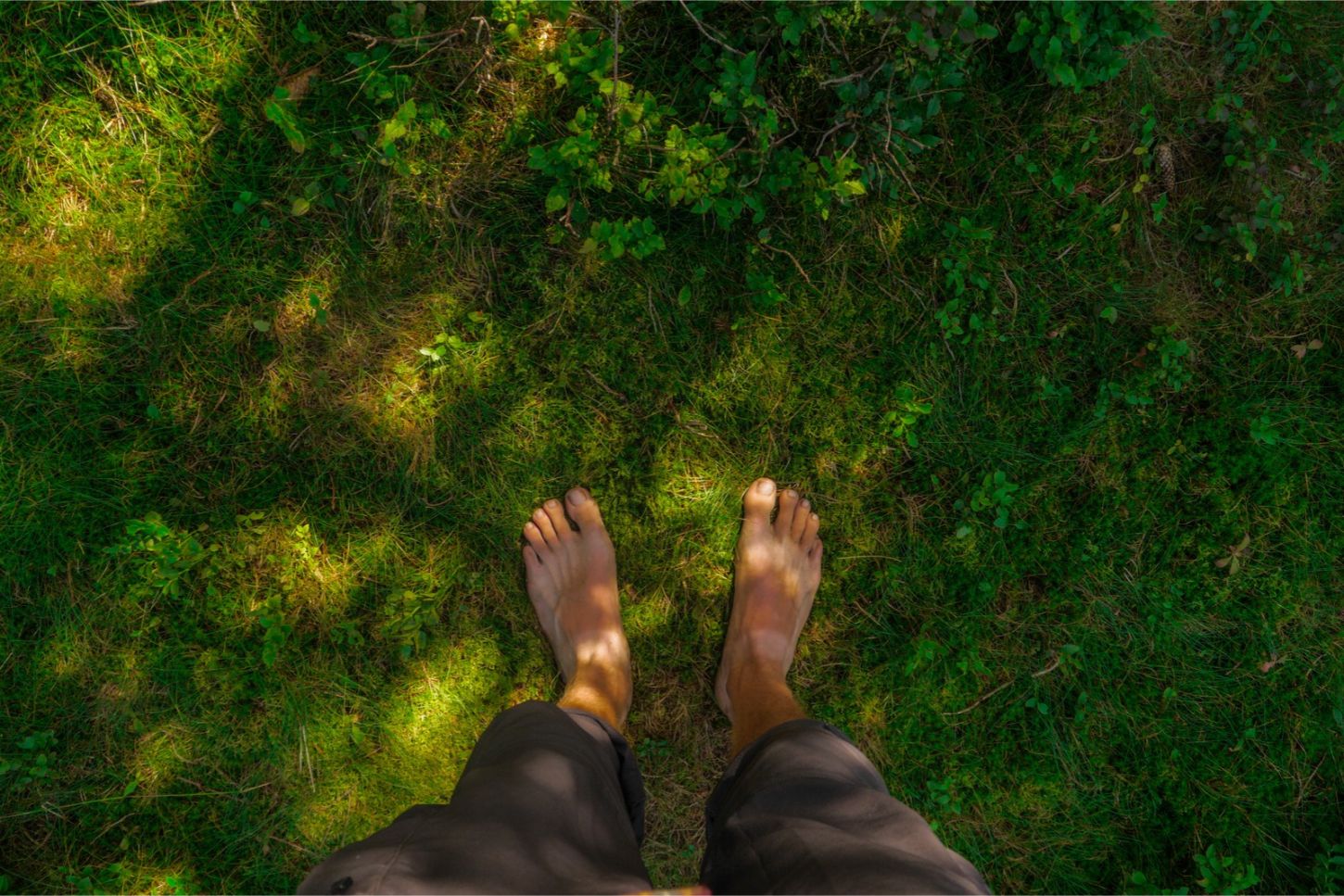
Roots in the earth, crown to the sun: four simple ways of grounding
Have you ever noticed how, after a long day at a screen, your head is buzzing and your body seems not to be there? Or how hard it is to return to everyday life after a powerful rite, deep prayer or meditation?
Back in 1989, in the German pagan magazine “HAIN”, Michael Frantz wrote that this is almost an occupational disease of magicians: a person gets stuck in the “higher spheres” and loses touch with the ordinary world, and then come dissatisfaction, spiritual stagnation, sometimes even anxiety and low spirits. The remedy, he says, is simple: ground yourself and don’t take everything so grimly. Only the one who does not laugh remains in danger.
Here are the exercises he describes. They require neither equipment nor a special place.
First, relaxation and your attention
Every meditation begins with relaxation. Everyday worries keep us on the surface like a cork and do not let us sink deeper. So first the whole body is relaxed step by step, and only then the still restless mind. You will sense for yourself when it is enough. The author admits he was unsure about this at first, but his doubts vanished once he began to trust his own feeling more.
The second foundation is concentration. Choose one thing: a candle flame, a flower, clouds, the wind, a hill, the touch of water. Keep your attention on it and let other thoughts fall away. Not by force, but persistently.
Grounding
You may sit, stand or lie down. Relax and let your breathing flow by itself. It sinks deep into the lower belly, where your centre of gravity and your centre of power lie.
With every in-breath, draw power from the earth up through your feet into this centre. With every out-breath it spreads through the whole body: refreshing, strengthening, healing. In just the same way everything you do not want, tension and worries, can drain away into the earth, which transforms it all.
Finish when you feel firm and calm within yourself. Then once more breathe in deeply as much power as you can, let it flow away as you breathe out, and open your eyes.
When there is too much power and you cannot handle it, another variant is suitable: squat or sit down, place your palms on the ground and imagine the excess draining away through them. Some people also touch the ground with their forehead or simply lie down on their back.
The Tree of Life
This, in the author’s words, is one of the most beautiful ways of grounding. Sitting, the roots grow straight from the pelvis; standing, from the feet. Being on the bare Earth is not essential, though it is recommended: imagine the roots pushing through the floor, concrete and paving until they reach the soil.
With every out-breath the roots go deeper. Then, breathing in, draw power through the roots into your centre, and breathing out let it rise slowly up your spine, your trunk, to your head. From it branches grow: first young shoots, then thick boughs, until a huge crown forms. It droops right down to the ground, and the power flows back. The circle closes: breathing in you take, breathing out you give back.
Finish as in the first exercise. Thank the Earth, if you feel so moved.

The World Axis
Many peoples know the world axis that joins the underworld, the earth and the sky. The Germanic peoples called it Yggdrasil, and a Lithuanian need only recall the World Tree in their own patterns and songs. In this exercise you become that link.
The beginning is as in the Tree of Life: roots, in-breath to the centre, out-breath up the spine. Only you do not grow branches. You give the power to the Sun through the crown of your head. With the next in-breath draw the Sun’s power through the crown of your head into the centre and, breathing out, send it into the Earth. So the direction changes with every breath: from Mother Earth to Father Sun, from Father Sun to Mother Earth.
When this becomes easy, try taking in both powers together as you breathe in and letting them pass each other as you breathe out. The breathing must remain free, the belly relaxed. The powers are guided, not pushed. We are only conductors.
At the end, with one in-breath draw both powers into the centre, spread them through yourself, bow and give thanks.
For those familiar with the chakras the author suggests a more complex variant: first gather power in the lowest chakra, rise upwards pausing at each one until it is felt clearly and pleasantly, and then descend, turning each in turn into the meeting place of Sun and Earth.
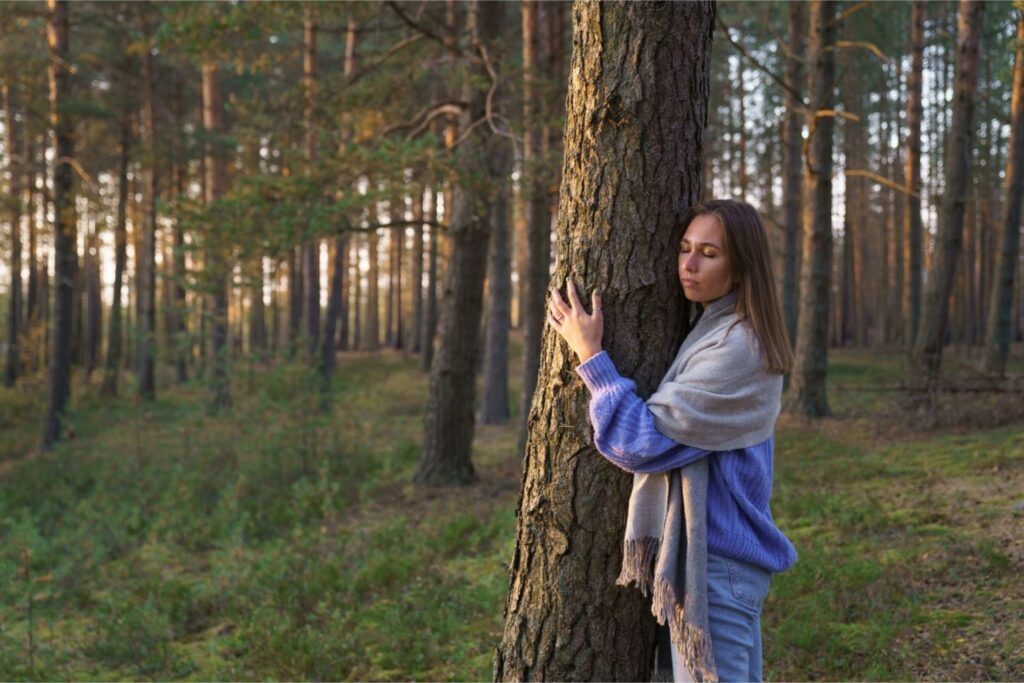
It is even better to do this practice barefoot and with your arms around a tree.
A stance nobody will notice
From Chinese Qi exercises the author borrows a basic stance that grounds by itself.
Stand loosely. Feet shoulder-width apart and parallel, not turned out as usual. Knees slightly bent, just so far that the thighs do not yet tire, and on no account locked back. Lean forward a little so that the weight rests on the front of the feet. Tilt the pelvis the way it tilts by itself when you sit down on a chair. Arms hang freely, shoulders dropped, spine straight but not stretched, the crown of the head pointing upwards.
Standing like this you will feel the weight with which you rest on the earth and that nothing can knock you over. Thoughts descend from the head into the belly, into deep trust, far from hurry.
Two movements are performed from this stance. First: as you breathe in, raise your arms to the sides like a crane or an eagle lifting its wings; as you breathe out, lower them. Elbows and wrists soft, the movement slow, as if you were drawing your arms through water. Second: palms at the hips, facing forwards. Breathing out, push them forward as if pushing something heavy; breathing in, bring them back. Then the same to the sides, upwards and downwards. Do not tense the shoulders: the movement is done not by the muscles but by the flowing power.
The author mentions the objection that this turns the Earth into a dumping ground, and dismisses it: our tensions are not plastic. What we give away returns to the same cycle it came from.
He also recalls the old belief that a witch loses her power if she is lifted off the ground. For him it is a symbol of how people are torn from their roots. The way back to them is open to everyone and begins with a breath that you let sink down to your feet.
Source: Michael Frantz, “Nature and Meditation. Part 2: In Contact with the Earth”, HAIN magazine, issue 4, 1989.